Página inicial > Glossário > Welt
Welt
domingo 28 de outubro de 2018
Welt, monde, mundo, world
«mundo»: en alemán, «Welt». Nótese que cada vez que la palabra Welt aparece entre comillas [Ser y Tiempo
GA2
Sein und Zeit
SZ
SuZ
S.u.Z.
Être et temps
Ser e Tempo
Being and Time
Ser y Tiempo
EtreTemps
STMS
STFC
BTMR
STJR
BTJS
ETFV
STJG
ETJA
ETEM
Sein und Zeit (1927), ed. Friedrich-Wilhelm von Herrmann, 1977, XIV, 586p. Revised 2018. [GA2] / Sein und Zeit (1927), Tübingen, Max Niemeyer, 1967. / Sein und Zeit. Tübingen : Max Niemeyer Verlag, 1972
] debe entenderse los entes del mundo, y no el mundo como estructura ontológica del Dasein. En el modo impropio de existir, el Dasein se comprende a sí mismo como si tuviese el mismo modo de ser que los entes del mundo, es decir, distorsiona su propio ser y oculta para sí mismo lo que le es más originario. [Rivera
Rivera
Jorge Eduardo Rivera
JORGE EDUARDO RIVERA CRUCHAGA (1927-2017)
; STRivera:Notas]
Regroupons tout cela d’après le tableau que dresse Marlène Zarader Zarader
Marlène Zarader Marlène Zarader (1949) (MZ1, page 118) :
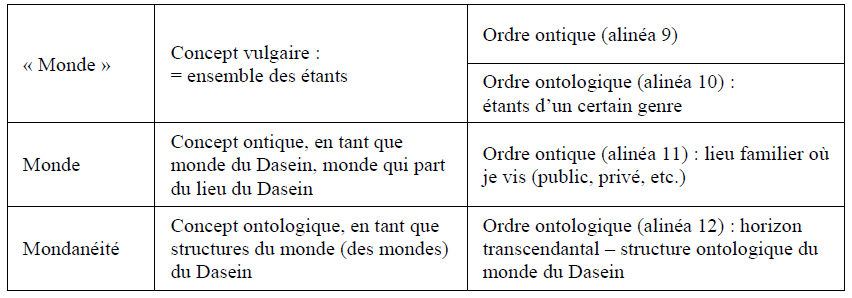
[Auxenfants
Auxenfants
Jacques Auxenfants
Jacques Auxenfants - tradutor em francês de Sein und Zeit
; ETJA
GA2
Sein und Zeit
SZ
SuZ
S.u.Z.
Être et temps
Ser e Tempo
Being and Time
Ser y Tiempo
EtreTemps
STMS
STFC
BTMR
STJR
BTJS
ETFV
STJG
ETJA
ETEM
Sein und Zeit (1927), ed. Friedrich-Wilhelm von Herrmann, 1977, XIV, 586p. Revised 2018. [GA2] / Sein und Zeit (1927), Tübingen, Max Niemeyer, 1967. / Sein und Zeit. Tübingen : Max Niemeyer Verlag, 1972
:§14N6]
O ser-aí é marcado por uma dinâmica ekstática originária. Foi isso que pudemos acompanhar detidamente no tópico acima. Essa dinâmica projeta imediatamente o ser-aí para fora de toda e qualquer interioridade imaginável. Nós nunca somos primeiro dentro, para depois nos relacionarmos com o fora, mas já sempre nos encontramos fora. Esse fora é um correlato estrutural do existir e a ele Heidegger dá o nome de mundo. Ser, para o homem, já sempre implica se ver abruptamente jogado no mundo enquanto campo histórico de possibilidades específicas. Mundo é o horizonte de manifestabilidade dos entes enquanto tais na totalidade, na expressão de uma preleção um pouco posterior a Ser e tempo GA2
Sein und Zeit
SZ
SuZ
S.u.Z.
Être et temps
Ser e Tempo
Being and Time
Ser y Tiempo
EtreTemps
STMS
STFC
BTMR
STJR
BTJS
ETFV
STJG
ETJA
ETEM Sein und Zeit (1927), ed. Friedrich-Wilhelm von Herrmann, 1977, XIV, 586p. Revised 2018. [GA2] / Sein und Zeit (1927), Tübingen, Max Niemeyer, 1967. / Sein und Zeit. Tübingen : Max Niemeyer Verlag, 1972 (1929/30) intitulada Os conceitos fundamentais da metafísica (mundo – finitude – solidão) [Cf. Martin Heidegger, Os conceitos fundamentais da metafísica (mundo – finitude – solidão), §68, p. 409]. A questão, com isto, passa a ser descrever propriamente tal horizonte e mostrar em que medida “as determinações de ser do ser-aí precisam ser vistas e compreendidas, então, a priori com base na constituição ontológica, que é denominada ser-no-mundo” [Martin Heidegger, ST, § 12, p. 53]. [MACMundo1:47]
VIDE: WELT E DERIVADOS
VIDE: Welt
mundo
monde
world
O acesso à questão do ser sempre se dá a partir de um horizonte [Horizont] sedimentado que transpassa e determina a priori todos os comportamentos [Verhalten] do ser-aí humano [Dasein]. Para designar esse horizonte, Heidegger se vale do termo “mundo”. Assim, a questão acerca do sentido do ser [Frage nach dem Sinn von Sein] pressupõe uma tematização prévia do conceito de mundo [Weltbegriff]. Enquanto horizonte de todos os comportamentos do ser-aí humano, contudo, o conceito de mundo se mostra desde o princípio em uma articulação essencial com o ser-aí. Não há mundo enquanto campo de manifestação dos entes em geral sem o ser-aí, assim como não há o ser-aí enquanto o ente [Seiende] existencialmente aberto para esse campo sem o mundo. Ao contrário, ser-aí e mundo são instâncias radicalmente copertinentes de um mesmo acontecimento. Tal como encontramos formulado em uma passagem do ensaio Da essência do fundamento: “O mundo pertence (…) justamente ao ser-aí humano, apesar de abarcar todo ente [Seiende], mesmo o ser-aí, em uma totalidade”. (EF, WM, GA9
GA9
Wegmarken
GA9PT
GA9ES
GA9EN
CartaH
Wegmarken (1919–1961), ed. Friedrich-Wilhelm von Herrmann, 1. Auflage 1976. 2., durchgesehene Auflage 1996
, 167) Além disto, o mundo encerra em si uma ligação originária com o ser, porque mundo se confunde em última instância com a compreensão de ser [Seinsvertständnis]. Com isto, nós nos deparamos aqui com a tríade fundamental de Ser e tempo
GA2
Sein und Zeit
SZ
SuZ
S.u.Z.
Être et temps
Ser e Tempo
Being and Time
Ser y Tiempo
EtreTemps
STMS
STFC
BTMR
STJR
BTJS
ETFV
STJG
ETJA
ETEM
Sein und Zeit (1927), ed. Friedrich-Wilhelm von Herrmann, 1977, XIV, 586p. Revised 2018. [GA2] / Sein und Zeit (1927), Tübingen, Max Niemeyer, 1967. / Sein und Zeit. Tübingen : Max Niemeyer Verlag, 1972
: ser, ser-aí e mundo. […] Em verdade, não é uma faculdade cognitiva, mas o próprio mundo que fornece a compreensão prévia [Vorverständnis] do ser dos entes [Sein des Seienden] em geral. E ele não o faz a partir de uma justaposição de compreensões de ser, mas antes como abertura una e total de um campo de manifestação, que vai produzindo paulatinamente a possibilidade de uma sedimentação das determinações dos modos de ser de todos os entes em geral. Com isto, o mundo não se mostra como o resultado de um somatório de compreensões de ser, mas muito mais como a determinação do ser do ente na totalidade [Seiende im Ganzen], uma determinação [Bestimmtheit] que traz consigo ao mesmo tempo uma pluralidade de determinações regionais do ser dos entes em geral. Ele é um campo de manifestação dos entes em sua totalidade, que nunca se confunde com a mera soma desses entes, mas que sempre se projeta para além de tal soma no momento em que buscamos alcançá-lo pela simples extensão de conteúdo. Cada mundo é uma ontologia [Ontologie] sedimentada que, enquanto tal ontologia, fornece incessantemente a medida para os comportamentos do ser-aí [Dasein]. No entanto, na medida em que essa ontologia é sempre instaurada a partir de uma compreensão de ser e em que não é possível pensar uma compreensão de ser para além do ente dotado do caráter de ser-aí, é justamente nesse ente que se encontra a via de acesso à constituição das ontologias em geral. [MACMundo1:22-24]
NT: "World" ("Welt"): defined, 58fn, 63-65, 89, 202, 246fn; abandoning (verlassen) the, 238; abandonment (überlassen) to the, 356, 406, 412-413; absorption in the, 184, 189; addressing oneself to the, 59; Being-together-with the, 175, 181, 189, 311, 352; taking care of the ‘world’, 136, 143, 175, 184-185, 252, 270, 277, 311, 338, 411; de-distancing the, 105; devotion to the, 136; discovering the, 110, 129, 203, 297, 312; falling into the, 175, 185, 189, 338; fascination with the, 176; having the, 58; knowing the, 138; letting the ‘world’ `matter’ to one, 139; losing oneself in the, 221, 348; presupposing the, 64; relationship to the, 57; seeing the, 138; spatializing the, 112; submission to the, 161, 297, 383; surrendering to the, 139; theoretical attitude toward the, 356; understanding the, 148, 201; understanding oneself in terms of the, 15, 22, 221, 411; Angst and the, 187, 189; fear and the, 189; nature and the, 25; reality and the, 183, 207; objective presence of the, 132, 192; alien, 356; as it looks, 172; Descartes Descartes H. consagrou dois cursos e quatro seminários a Descartes. A desconstrução da metafísica heideggeriana conduz um diálogo intenso com Descartes. on, 99-101. See also external world; multiplicity; thingliness [BTJS GA2
Sein und Zeit
SZ
SuZ
S.u.Z.
Être et temps
Ser e Tempo
Being and Time
Ser y Tiempo
EtreTemps
STMS
STFC
BTMR
STJR
BTJS
ETFV
STJG
ETJA
ETEM Sein und Zeit (1927), ed. Friedrich-Wilhelm von Herrmann, 1977, XIV, 586p. Revised 2018. [GA2] / Sein und Zeit (1927), Tübingen, Max Niemeyer, 1967. / Sein und Zeit. Tübingen : Max Niemeyer Verlag, 1972 ]
NT: ‘. . . innerhalb der Welt . . .’ Heidegger uses at, least, three expressions which might be translated as ‘in the world’: ‘innerhalb der Welt’, ‘in der Welt’, and the adjective (or adverb) ‘innerweltlich’. We shall translate these respectively by ‘within the world’, ‘in the world’, and ‘within-the-world’. [BTJS GA2
Sein und Zeit
SZ
SuZ
S.u.Z.
Être et temps
Ser e Tempo
Being and Time
Ser y Tiempo
EtreTemps
STMS
STFC
BTMR
STJR
BTJS
ETFV
STJG
ETJA
ETEM Sein und Zeit (1927), ed. Friedrich-Wilhelm von Herrmann, 1977, XIV, 586p. Revised 2018. [GA2] / Sein und Zeit (1927), Tübingen, Max Niemeyer, 1967. / Sein und Zeit. Tübingen : Max Niemeyer Verlag, 1972 ]
NT: World (Welt): defined, 63-65, 72, 75, 364-365, 380, 414; in the marginal remarks (=fn): 52fn (concept of), 58fn (Da-sein never "has"), 65fn, 88fn (its sway), 101fn (also spatial), 246fn; abandonment to the, 172, 412; absorption in the, 125, 129-130, 172, 192; being-together with the, 54, 119, 146, 194, 277; being-already-together with-the, 61, 109, 277; being-no-longer-in-the, 176, 238, 240; being-with-one-another-in-the, 238-239, 384; belonging-to-the, 65, 381; taking care of the, 61, 199, 253, 277, et passim; discovering the, 55, 129, 138, 165, 195, 203; disclosedness of the, 76, 137, 139, 141, 145-146, 186-188, 202-203, 210-211, 220, 272, 297, 333, 364-365, 368, 412, 419-420; familiarity with the, 76, 86; fascination with the, 61; fleeing the, 254; getting ‘lived’ by the, 195-196; going-out-of-the, 238, 240; having-been-in-the, 394; interpreting, 129; letting the world ‘matter’ to one, 170; openness to the, 137; presupposing the, 361, 365; relations to, 57; submitting to the, 137-138, 139; surrendered to the, 199; thrown into the, 192, 199, 221, 228, 348, 413; understanding the, 16, 86, 146, 148, 152, 168, 366; Angst and, 186-188, 335, 343; Mitdasein and, 121-123, 137; fear and the, 141; the objectively present and, 57, 130, 369; reality and, 106, 203, 211; the things at hand and, 75-76, 83, 106, 119, 122, 137; resoluteness and, 298-299; significance and, 111, 144-145, 147, 151, 166, 186, 297, 335, 343, 366, 423; spatiality and, 101-113 (§§ 22-24),369; being-there of the, 132; occurrence of the, 389; ‘natural conception’ of, 50-52 (§ 11); the "nothing" of the, 187, 189, 276, 335, 343; ontology of, 100; ‘subjectivity’ of, 36; transcendence of, 350-366 (§ 69, esp. 69c), 419; alien, 172; historical, 376, 381, 388-389; past, 380; primitive, 82; projected, 394; public, 71; spiritual, 47 n. 2; we-world, 65; wish-world, 195; of useful things, 354, 359, 413; of plants and animals, 246; that has been, 381; that has-been-there, 393-394; that is no longer, 380; world-conscience, 278; world-history, 19-20, 332, 377, 387-397 (§§ 75, 76), 428 n. 17 (Hegel Hegel
Georg Wilhelm Friedrich Hegel Georg Wilhelm Friedrich Hegel (1770-1831) ), 434 (Hegel Hegel
Georg Wilhelm Friedrich Hegel Georg Wilhelm Friedrich Hegel (1770-1831) ); world-point, 362; world-space, 54, 104; world-structure, 366, 414; world-stuff, 71, 85; world-time (See entry under ‘time’ above); world-view (Weltanschauung), 180, 200, 301 n. 17 (Jaspers Jaspers
Karl Jaspers KARL JASPERS (1883-1969) ), 392, 396; is not an entity within-the-world, 72, 118; Da-sein is its, 364; is there, 144; frees beings, 123, 129; How death ‘came into the world’, 248; Descartes Descartes H. consagrou dois cursos e quatro seminários a Descartes. A desconstrução da metafísica heideggeriana conduz um diálogo intenso com Descartes. on, 89-90; Husserl Husserl
Edmund Husserl EDMUND HUSSERL (1859-1938) on, 47 n. 2; Kant Kant Emmanuel Kant (Immanuel en allemand), 1724-1804, é um dos autores de predileção de H., um daqueles do qual mais falou. on, 108, 321. See also Being-in-the-world; Surrounding world; With-world [BTJS GA2
Sein und Zeit
SZ
SuZ
S.u.Z.
Être et temps
Ser e Tempo
Being and Time
Ser y Tiempo
EtreTemps
STMS
STFC
BTMR
STJR
BTJS
ETFV
STJG
ETJA
ETEM Sein und Zeit (1927), ed. Friedrich-Wilhelm von Herrmann, 1977, XIV, 586p. Revised 2018. [GA2] / Sein und Zeit (1927), Tübingen, Max Niemeyer, 1967. / Sein und Zeit. Tübingen : Max Niemeyer Verlag, 1972 ]
Welt (die): «mundo». «Mundo» es uno de los conceptos centrales de la hermenéutica de la vida fáctica que el joven Heidegger lleva a cabo en los primeros cursos de los años veinte. En los primeros cursos de Friburgo, el mundo se despliega en «mundo circundante» (Umwelt), «mundo compartido» (Mitwelt) y «mundo propio» (Selbstwelt). Estos tres mundos se dan cooriginariamente y se integran plenamente en la estructura relacional del «estar-en-el-mundo» (In-der-Welt-sein). Los guiones que con tanta frecuencia utiliza Heidegger no pretenden otra cosa que resaltar los nexos intencionales de toda estructura ontológica. «Mundo» no tiene aquí un sentido espacial, no representa la totalidad de entes contenidos en un receptáculo, sino que encierra una dimensión vivencial; esto es, Welt es el ámbito, el contexto, el horizonte en que se desarrolla la vida del ser humano desde la triple posibilidad de: a) su trato con las demás personas en el ámbito del mundo compartido (Mitwelt); b) del uso que hace de las cosas en su relación diaria con el mundo circundante (Umwelt); c) del mundo de sus propios pensamientos, sentimientos y vivencias (Selbstwelt). Más tarde, esta distinción tan marcada entre lo que podríamos llamar el mundo objetivo, intersubjetivo y subjetivo se diluye en Ser y tiempo GA2
Sein und Zeit
SZ
SuZ
S.u.Z.
Être et temps
Ser e Tempo
Being and Time
Ser y Tiempo
EtreTemps
STMS
STFC
BTMR
STJR
BTJS
ETFV
STJG
ETJA
ETEM Sein und Zeit (1927), ed. Friedrich-Wilhelm von Herrmann, 1977, XIV, 586p. Revised 2018. [GA2] / Sein und Zeit (1927), Tübingen, Max Niemeyer, 1967. / Sein und Zeit. Tübingen : Max Niemeyer Verlag, 1972 , donde ya no se habla del mundo propio. Para un sugestivo análisis de la etimología de la palabra Welt, remitimos al diccionario de Grimm, una de las herramientas de consulta preferidas por Heidegger. Según Grimm, la palabra Welt se remonta etimológicamente al término del alto alemán antiguo Wer-alt, que en el siglo XII queda fijado como Welt y tiene el sentido de «el todo de la creación, de la tierra como lugar de residencia del hombre en contraposición a la inhabitabilidad del mar». Un sentido que contrapone el desarrollo de las comunidades humanas al estado salvaje que amenaza a la vida humana. En este sentido, Welt incluye también la dimensión comunitaria que Pablo otorga a la palabra κόσμος [kosmos] en sus epístolas y de la que Heidegger da cuenta en sus lecciones de 1920-1921, Fenomenología de la vida religiosa. [GA56/57, pp. 73 (mundea), 89, 91, 94; GA58 GA58
GA 58
GA LVIII
WS 1919-1920
KNSWS 1919-1920
KNS
Kriegsnotsemester Grundprobleme der Phänomenologie (WS 1919-1920) [1992] — Problemas Fundamentais da Fenomenologia (1919-1920). KNS = Kriegsnotsemester , pp. 33 (mundo compartido, circundante, propio), 36, 41, 45-46 (mundo compartido); GA59 GA59
GA 59
GA LIX
SS 1920 Phänomenologie der Anschauung und Ausdrucks. Theorie der philosophischen Begriffsbildung (SS 1920) — Fenomenologia da Intuição e da Expressão , p. 173; GA60 GA60
GA 60
GA LX
EMM Phänomenologie des religiösen Lebens [1995]; Estudios sobre Mística Medieval. Tr. Jacobo Muñoz. México: Fondo de Cultura Económica, 1997. , pp. 11, 12 (mundo vida), 69, 88, 98, 119 (facticidad), 228-232; GA61 GA61
GA 61
GA LXI
GA61EPG
GA61JAE
GA61RR
WS 1921-1922 Phänomenologische Interpretationen zu Aristoteles: Einführung in die phänomenologische Forschung (WS 1921-1922) [1985] , pp. 85, 94-95, 101, 130; NB NB GA19 - Natorp Bericht (Phänomenologische Interpretationen zu Aristoteles. Anzeige der hermeneutischen Situation) (Informe de 1922), en: Dilthey-Jahrbuch 6 (1989), pp. 237-274. Editado por Hans-Ulrich Lessing.
Hermeneutica de la vida humana. En torno al Informe Natorp de Martin Heidegger , pp. 21 (significatividad), 22, 26 (huida del mundo), 52-53; GA63 GA63
GA 63
GA LXIII
SS 1923 Ontologie. (Hermeneutik der Faktizität) (SS 1923) [1988] — Ontologia. Hermenêutica da Facticidade , pp. 85-86, 96, 98; GA17 GA17
GA 17
GA XVII
GA17ES
GA17EN Einführung in die phänomenologische Forschung (Wintersemester 1923/1924), ed. Friedrich-Wilhelm von Herrmann, 1. Auflage 1994. 2., unveränderte Auflage 2006. , pp. 28, 39 (posibilidad de engaño), 44, 49-50; GA20 GA20
GA20ES
GA20EN Prolegomena zur Geschichte des Zeitbegriffs (Sommersemester 1925), ed. Petra Jaeger, 1. Auflage 1979. 2., durchgesehene Auflage 1988. 3., durchgesehene Auflage 1994. , pp. 219 (objetivo), 226-231 (mundanidad del mundo, cuidado, desmundanización), 249, 250 (naturaleza), 252-259 (carácter de comparecencia del mundo), 266, 292, 294-297 (mundo exterior, realidad del mundo), 301, 304, 307, 330-333 (mundo apresentado), 339, 401; GA21 GA21
GA 21
GA XXI
GA21EN
GA21ES Lógica. A pergunta pela verdade. / Logik. Die Frage nach der Wahrheit (Wintersemester 1925/1926), ed. Walter Biemel, 1. Auflage 1976. 2., durchgesehene Auflage 1995. , pp. 245 (mundo-naturaleza), 247; GA24 GA24
GP
BP
PFF
GA 24
GA XXIV
GA24AH
GA24JFC
GA24MAC
GA24FR
GA24ES
GA24EN
GA24PT Die Grundprobleme der Phänomenologie (Summer semester 1927), ed. F.-W. von Herrmann, 1975, 2nd edn. 1989, 3rd edn. 1997, X, 474p. , pp. 236 (mundo circundante), 237, 239, 241 (naturaleza), 420, 422, 424 (mundo = lo propiamente trascendente); SZ GA2
Sein und Zeit
SZ
SuZ
S.u.Z.
Être et temps
Ser e Tempo
Being and Time
Ser y Tiempo
EtreTemps
STMS
STFC
BTMR
STJR
BTJS
ETFV
STJG
ETJA
ETEM Sein und Zeit (1927), ed. Friedrich-Wilhelm von Herrmann, 1977, XIV, 586p. Revised 2018. [GA2] / Sein und Zeit (1927), Tübingen, Max Niemeyer, 1967. / Sein und Zeit. Tübingen : Max Niemeyer Verlag, 1972 , pp. 63-66 (polisemia del mundo), 83-88 (mundanidad del mundo), 86, 89-101 (mundo en Descartes Descartes H. consagrou dois cursos e quatro seminários a Descartes. A desconstrução da metafísica heideggeriana conduz um diálogo intenso com Descartes. ), 123 (ser con de los otros), 152, 187, 200-212 (Dasein, mundo, espacialidad), 350-366 (trascendencia del mundo), 364-366 (trascendencia), 365, 393, 405, 419 (tiempo del mundo).] [LHDF]
1. “Welt’, ‘weltlich’, ‘Weltlichkeit’, “Weltmässigkeit’. We shall usually translate ‘Welt’ as ‘the world’ or ‘a world’, following English idiom, though Heidegger frequently omits the article when he wishes to refer to ‘Welt’ as a ‘characteristic’ of Dasein. In ordinary German the adjective ‘weltlich’ and the derivative noun ‘Weltlichkeit’ have much the same connotations as the English ‘worldly’ and ‘worldliness’; but the meanings which Heidegger assigns to them (H. 65) are quite different from those of their English cognates. At the risk of obscuring the etymological connection and occasionally misleading the reader, we shall translate ‘weltlich’ as ‘worldly’, ‘Weltlichkeit’ as ‘worldhood’, and ‘Weltmässigkeit’ as ‘worldly character’. The reader must bear in mind, however, that there is no suggestion here of the ‘worldliness’ of the ‘man of the world’. [BTMR GA2
Sein und Zeit
SZ
SuZ
S.u.Z.
Être et temps
Ser e Tempo
Being and Time
Ser y Tiempo
EtreTemps
STMS
STFC
BTMR
STJR
BTJS
ETFV
STJG
ETJA
ETEM Sein und Zeit (1927), ed. Friedrich-Wilhelm von Herrmann, 1977, XIV, 586p. Revised 2018. [GA2] / Sein und Zeit (1927), Tübingen, Max Niemeyer, 1967. / Sein und Zeit. Tübingen : Max Niemeyer Verlag, 1972 ]
